A Gentle Reminder. . .
April 21, 2009
Just a reminder that DDD has moved! The new address is http://rickiheller.com , in case you wish to update your readers and blogrolls 🙂
Hope to see you there!
Diet, Dessert and Dogs has Moved!
March 24, 2009
DIET, DESSERT AND DOGS HAS MOVED!
If you’re reading this post, you’ve landed on the last post on the old site.
Please follow us over to the shiny NEW Diet, Dessert and Dogs by clicking here.
And if you arrive before March 31, 2009, you can enter to WIN SOME FREE MAPLE SYRUP OR A CUSTOM BAKED CAKE!
Hope to see you there! Drop by at http://dietdessertndogs.com! 🙂
“Mum, the new home is so nice–very roomy and comfortable. But we still haven’t managed to find the stash of treats. . . you didn’t forget to bring them along, did you?”
THIS SITE HAS MOVED!

A vibrant and refreshing salad to help usher in the spring season. . .
To read the blog post and see the recipe, please come on over to my new blog home, Diet, Dessert and Dogs! Just click here.
There’s also a great giveaway over there you might like to find out about. . . 🙂
© 2009 Diet, Dessert and Dogs
Sweet (Freedom) Giveaway–and Blog News!
March 20, 2009
First, the blog news: I’ve got a new blog home! (Well, almost–we’re about 95% moved in and unpacked so far. . . we’ve still got to add a virtual top coat of paint, rearrange some html furniture and hang some digital pictures before the rest is up and running over the next week or so, but everything is on site and functional!). Please drop by to check it out, and don’t forget to change your Google Reader, other subscription info and blogrolls (it’s also much easier to subscribe to this new site, so hope that helps–and note that the page tabs are now across the top of the page, not on the right as in this site!). I’ll be transferring over there for good by next week. And now–ta da!–here’s the new home of
The site was set up and arranged by Blain Smith of 13 Infinite. It’s been a pleasure to work with him on this–Blain’s communication style is easy and relaxed, yet always professional. He’s also been very accommodating and incredibly quick about responding to all my emails regarding the site (not to mention very patient with my sometimes endless questions and requests!). If you’re looking to set up a new blog, I’d highly recommend him.
Next, the cookbook news: my cookbook finally has a cover!

(I’m guessing you might recognize some of those photos? And I know, the red, white and blue looks very patriotic,no?) 😉
Finally, the Double Giveaway News!!
I am very excited for this giveaway because it’s the perfect melding of my new blog, my new cookbook, and a product I love!
In honor of the cookbook’s cover being finalized, I decided to throw another giveaway to celebrate–add a new blog home, and it’s really a reason to party! (Get those chandeliers and lampshades ready!)
So here’s the scoop:
WHAT YOU CAN WIN
PRIZE ONE: ANYONE IN NORTH AMERICA CAN WIN (again, a HUGE apology to my overseas readers–shipping costs prohibit overseas delivery. BUT I DO PROMISE THAT THE NEXT GIVEAWAY WILL ABSOLUTELY INCLUDE ANYONE ON THE PLANET!)
Win a quart-sized jug of Coombs Family Farms Pure Maple Syrup!

[This is a photo of the glass bottle I received–the quart jug prize is four times this big!]
Yes, the prize is the same amazing maple syrup I wrote about in my previous post. And when the people at Coombs Family Farms heard how much I loved their syrup, and how much my readers wished they could taste some, they said, “Okay! Let’s give some away!” Who am I to argue? I said, “YEEEE-AAH.”
With a full quart (about a liter) of pure maple syrup, you can bake every maple-based recipe on this blog, and probably all the maple-based recipes in my new book, too! And I can’t wait for one of you to sample this extraordinary product as well, and tell me what you think!
PRIZE TWO: THOSE IN THE TORONTO AREA CAN WIN (to ensure freshness, it has to be within the general Toronto area, or you must be willing to meet me within Toronto–I am really sorry it can’t be everywhere! sniff!)
A custom-baked chocolate layer cake from the Sweet Freedom recipe–made to your specifications!

After I posted about the cake I made for my friend Eternal Optimist’s birthday, I was touched by so many positive comments about the cake. This is the same recipe I used for several years when I baked birthday cakes for kids with food sensitivities to wheat, eggs, dairy and refined sugar–and was a regular hit with the kids and adults alike (low-gluten, but not gluten free). The 9-inch layer cake serves 10-12 people comfortably.

Now, I’d love for a lucky reader to sample this chocolately, moist and light cake, too! And you get to design the frosting/filling, plus whether you’d like a message on the cake as well. (We’ll choose a mutually convenient delivery time so that you can even plan to serve the cake to family, friends, or party guests!)

Here’s what you can choose:
-
Chocolate layers with vanilla pastry cream filling and chocolate buttercream frosting
-
Chocolate layers with all chocolate–filling and frosting
-
Chocolate layers with sweet potato truffle filling and chocolate frosting
-
Chocolate layers with chocolate filling and sweet potato truffle frosting (the cake in the photo above)
-
Message of your choice in any color frosting (or no message–it’s up to you).
I’ll deliver the cake freshly baked and frosted so it’s ready to serve!
HOW TO ENTER:
Entering couldn’t be easier–simply click on over to my new blog home, take a look around, then let me know either:
1) what more you’d like to see on the blog (any other features you’d like me to add? Something you’re missing from the old blog? –etc.) OR
2) what you like best about the new blog if you can’t think of anything you’d like to be different.
FOR A CHANCE AT TWO EXTRA ENTRIES, simply mention the contest on your own blog, if you have one, and link to this very page on the new blog (ie, this page).
Don’t have a blog? You can still earn two extra entries! Simply browse through the Recipe Index on the new DDD and choose a favorite recipe that uses maple syrup (some of the links haven’t been shifted to the new blog yet, so you might still be in the old blog when you click on a recipe title–I’m in the process of changing them all over). Then comment again, letting me know which one you like best, and why–and you’ll be entered two more times.
Please be sure to include a valid email address so I can get in touch with you if you win.
That’s it!
Please post your comments on the new site to be eligible to win (that way I can keep track of all the entries in one place). 🙂
HOW IT WILL WORK:
Once the contest closes, I’ll choose two winners from a bag of names. The first Toronto-area name I withdraw will win the cake. Then all the other names go back into the bag for the maple syrup draw, and the second name I choose wins that.
DEADLINE AND ANNOUNCEMENT:
-
Deadline for entries is midnight, March 31, 2009, Toronto time.
-
Winners will be announced first thing on April 2, 2009 (I wouldn’t dare post contest winners on April Fool’s Day!).
I loved baking up a storm for the previous giveaway, and was thrilled with Lisa’s kind words about the Sweet Freedom goodies.
I can’t wait to get baking on this cake for you this time round as well. And even if you can’t win the cake, you’re still eligible to win the syrup–so you can then bake your own delectable treats!
HAPPY SPRING, EVERYONE!
Maple Mania, Part I: Marvelous Maple-Flax Cookies!
March 17, 2009
Diet, Dessert and Dogs has moved! If you’re reading this page, you’ve landed on the old site. Please visit the new location by clicking here–and don’t forget to update your readers and blogrolls!
As always, thanks for reading. I look forward to seeing you at the shiny new Diet, Dessert and Dogs!
“Um, Mum, we are coming with you, aren’t we? Because (and sorry to have to tell you this), we actually have more fans than you do on this blog.”]

A few weeks ago, I was contacted by Coombs Family Farms, an organic farm in Vermont that specializes in “all things maple,” to see if I’d like to sample some of their syrup. Since maple syrup is a well-loved staple in my kitchen and many of my baked goods feature it as a key sweetener, I was delighted to accept their offer and eagerly awaited the package.
A few days later, I received this:
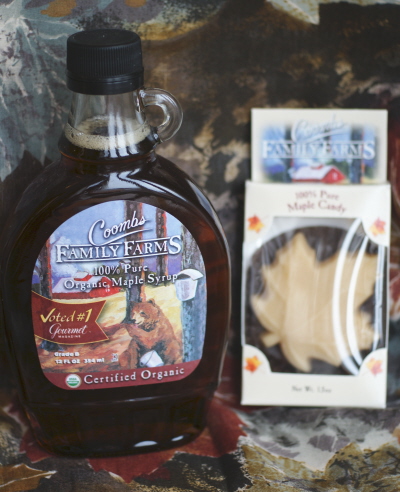
A bottle of their certified organic syrup, along with a maple-leaf shaped piece of maple candy!
Anyone who’s ever consumed real maple syrup can attest to its unique flavor–sweet, slightly smoky, with an appealing, earthy aroma. Made from the sap of maple trees, it’s naturally rich in minerals (per volume, higher in calcium than dairy milk!). The syrup is available for purchase in three grades of A (light, medium and dark) and one of B–each darker and more intensely flavored than the last. I was sent a bottle of grade B, an intense, soulful auburn that was so thick and deep it was nearly opaque. As soon as I removed the cap, the maple perfume escaped to envelop the room with that distinctive scent.
Now, I’ve enjoyed maple syrup for many years. Like pretty much everyone raised in Quebec–the heart of Canada’s maple country–I consider myself a maple aficionado, if not an expert. Maple syrup is ubiquitous in La Belle Province: you can find it on every checkered tablecloth in every greasy-spoon breakfast diner, cheerily lining the shelves in corner grocery stores, awaiting the call in every kitchen cupboard. When I was in grade school, each spring our class would make an annual trek up north for “sugaring off” parties, where freshly tapped, warmed maple syrup was poured over vast expanses of pristine snow to create a kind of maple taffy that we kids scrambled to scoop up with plastic spoons. I might even classify myself as a bit of a maple syrup snob, in fact, one who’d never even consider trying the artificially flavored stuff from that iconic slender-waisted bottle.
Still, despite my fine maple sensibilities, I’ve never really thought it essential to buy organic maple syrup. For one thing, the price is usually, shall we say, immoderate. In addition, I’ve always recalled a conversation I had with a student once in a sociology of food course I was teaching. She mentioned that her family owned a local maple tree farm. There was really no difference between organic and non-organic syrup, she explained, since most maple trees aren’t sprayed with pesticides anyway (unless infected by some vermin or another). I filed away that bit of information and continued to purchase my regular (non-organic) variety.
Well, let me tell you, that student got it wrong (luckily, she wasn’t writing a test at the time). Now that I’ve tasted the Coomb’s organic version, I’m not sure I can go back to my generic brand. Their syrup is outstanding, with a rich, deep amber color and more intense maple flavor than I’ve ever tasted. It’s perfectly sweet and subtly smoky, with a heightened maple essence that lingers gently on the palate, enduring like an unexpected compliment.
Seriously, I may not be able to tolerate my old brand any more. To heck with the price–I’ll just have to be more judicious in my use of it, I reckon. Or else use a bit less and savor every drop more. Or simply ignore the cost entirely (I suspect that a pawn shop may come into play at some point). Seriously, it’s that good.
My first taste of the syrup was straight, poured onto the Lemony Almond Pancakes I wrote about a few days ago (I wanted to sample the delicacy in its pure, unadulterated state before combining it with other ingredients). The flavors melded beautifully, the maple’s presence strong enough to match the zesty lemon while counterbalancing the slight sourness of it. The HH practically asked to drink the stuff straight out of the bottle (but I wouldn’t let him, of course, as I was saving it for my subsequent kitchen experiments). He did manage to polish off the maple candy in one sitting, however–I got barely a nibble!
With such a winning flavor, I opted to design a cookie that would really showcase the unique taste that is “maple.” I concocted these Maple Flax cookies (sorry, the two of you who are also on the ACD; these are NOT ACD-friendly–I created this recipe a couple of weeks ago). They are naturally gluten free (and even flour-free, in fact). In this case, the light, chewy texture was a natural outgrowth of my desire to minimize other ingredients in order to allow the natural maple to shine through. And you will most definitely taste it, with every chewy, sticky, sweet and maple-y bite.
Thanks again to everyone at Coombs Family Farms for allowing me to sample this extraordinary product. Now my only lament is that I can’t find any more of it here in Toronto!
They’re not quite Irish, but since they contain oats, I can claim a Celtic connection, anyway. . . Happy St. Patrick’s Day, everyone!
P.S. It’s time for another Sweet Freedom giveaway. . . stay tuned for details next post! 🙂
Maple Flax Cookies
TO VIEW THE COMPLETE RECIPE, PLEASE VISIT THIS PAGE ON THE NEW DIET, DESSERT AND DOGS, BY CLICKING HERE.

Looking somewhat like oatmeal cookies, with a crunchy exterior and chewy center, these intesely maple-flavored treats will please everyone. Whole flax seeds add bulk, while the oatmeal and flax meal both contribute heart-healthy soluble fiber.
© 2009 Diet, Dessert and Dogs
TO VIEW THE COMPLETE RECIPE, PLEASE VISIT THIS PAGE ON THE NEW DIET, DESSERT AND DOGS, BY CLICKING HERE.
Last Year at This Time: Katie’s Creamy Aspara-Dip
Tomorrow: Cookies. Today: Reflections on ACD, Week One
March 16, 2009
[It was great to read so many positive messages from all you okra fans in response to my last post. Who knew there were so many okra supporters out there? Here’s to a new image for our pal okra! To the dawning of the age of okra–a new era is born, and it’s brimming with green pods and seeds! Okra is cool! Okra is au courant! Okra rules! O-Kra! O-Kra! O-Kra! Whoo!]

[No, you’re not allowed this on the ACD diet. Image courtesy of Naijablog.]
Now that I’ve completed my first week of strict adherence to the Anti-Candida Diet (ACD), I thought I’d put down some thoughts and reactions for those of you who are contemplating embarking on it, or for those who are simply curious. (If you’re here seeking a new recipe, please come back tomorrow–we’ll have cookies!)
First, I am thrilled to say I have not veered even one iota from the procrustean parameters of the diet. Having said that, I’m also amazed at how difficult I am finding it this time round.
Maybe I’d just forgotten how painful the process was last time, nine years ago, but I don’t recall struggling with it this much back then. Somehow, a decade made all the difference! True, I am also nine years older, and nine years closer to the dreaded “M” stage of life. ** Or maybe those little candida critters have been pumping iron in the interim and are now more resilient than ever.

[You are allowed burgers (sans bread)–but who would want one? Image courtesy of Beltway Confidential.]
As I mentioned in my previous post, this diet requires elimination of any food that could feed yeast or help yeast to grow (ie, allergens, toxins, etc.), leaving precious little to eat. For omnivores, the bulk of the diet would become meat, chicken, fish, eggs. But if you don’t eat those foods, not much else remains once you cut out all grains and fruits, plus some veggies (okay, not all grains; I’m allowed 1/4 cup of one gluten-free grain per day)–not to mention sauces, condiments, alcohol, fermented foods, and so on.
Here’s what you should know if you’re curious about trying the ACD.
The Challenges:
Because I’d done this before, I was already aware of a few of these challenges, which made it a bit easier to follow the diet. Still, it can be very difficult to stick with it unless you’re prepared for some of the following.
- No Dessert for You. Since most people on this diet are addicted to sweets, cutting out the usual baked goods, puddings, candies, cakes, pies, etc. is really tough. Initially, my body went carb-crazy and I had to eat something every two hours or so to keep my blood sugar levels steady. This passed by day three (thankfully–it can really mess up your schedule!). I’ve also managed to create a few ACD-friendly “desserts”–which I’ll post anon.

[Here’s your dessert on the ACD. Image courtesy of Innocent Creativity blog.]
- Precious Few Grains. The first phase of the diet eliminates most carbs, and allows very few of the “acceptable” ones. To my mind, it seems very similar to a low-carb or low-GI diet. Which would make sense, I suppose, since its purpose is to starve off candida albicans–an organism that feeds on sugar (including blood sugar).
- Hunger. Perhaps I should more accurately designate the feeling as “unresolved cravings.” I mean, I can count on one hand the times I’ve experienced true hunger. On this topic, I think Mark Bittman has something useful to say. A couple of weeks ago, I heard an interview with the man, discussing his newest tome, Food Matters. Among other things, Bittman mentioned how his “vegan until six” diet plan helped him lose 35 pounds and regain his health.
In the radio interview, he was asked how he managed to alter his diet so radically and still stick with the plan. His response was enlightening (and I paraphrase liberally here): “Well, consider the three major needs in our lives, for food, sleep, and sex. We all learn to control our sexual urges fairly early on; and certainly most of us in the working world regularly ignore our need for sleep. Yet we never, ever, in our society, are willing to allow ourselves to feel hungry. Like needs for sex and sleep, why can’t we just ignore it when we feel hungry sometimes?”
For me, Bittman’s comment was a little epiphany. Clearly, my appetite is telling me to eat when I don’t actually require more food; the ACD supplies all the nutritional requirements necessary. What I’m fighting is the desire for those last six Hershey kisses just because they’re left at the bottom of the bag (and really, why would you leave six little kisses sitting there?) or the mindless crunching on handfuls of Red Hot Blues because I just got home from work and dinner won’t be ready for a couple of hours and what else am I going to do while I peek intermittently at Oprah?–well, you get the idea. Remembering Bittman’s advice this past week allowed me to overcome those cravings, at least most of the time.
- Die-Off Reaction. As the yeasty beasties die off, they release toxins into the system that must then be filtered and cleared out by your own detoxification systems of liver and kidneys. This can be tough on your body. The second day of the diet, I was convinced I was coming down with a flu: my forehead pulsated, my muscles felt weak, all I wanted to do was sleep. By day three, it had disappeared. Even though you may feel worse initially, it’s important to push through.
The Benefits:
It’s been a mere seven days, but already I can recognzie a few of the benefits of this cleanse:
- Symptoms abate. Almost immediately, I noticed that my chronically blocked sinuses began to clear. I had a strange sensation of, “hey! What’s all that air in my nose?” before I realized, “oh, THIS is what it feels like to breathe out of both nostrils.” Similarly, the muscle weakness disappeared, some tummy grumblings cleared significantly, eyes were less swollen in the AM, and so on.
- Clarity of Thought. One of the oft-mentioned symptoms of candida overload is fuzzy thinking or inability to concentrate. This will begin to clear once the yeast begin to die off, after about 3 days or so.
- Energy. Yeast and other toxins sap your energy. Once they begin to take a hike, your energy returns–and you’re suddenly intensely grateful for the extra hours you have during each day to blog, read, meditate, spend time with loved ones, or do anything else you please.

[I concur, Mum–it’s great to have boundless energy! You should try rolling on the grass some time!]
I won’t be chronicling the events of every week in this much detail, but will likely mention the more significant milestonres every now and again as I move through the process over the next five weeks. If anyone has any specific questions about the diet or the experience, please let me know and I’d be happy to address them in an upcoming post as well.
“Um, Mum, you know that no one could be more serious about food and eating than we are. . . but really, I think you need to take a chill pill on this one. Because this post is really a downer.”

I don’t mean this post as a downer. The ACD will tax your willpower and force you to confront your worst eating habits. . . but that can be a really good thing. For me, it’s a necessity. Well, every nine years or so, anyway.
** no, not “Marriage,” though that might throw me just as much. I meant “Menopause.”
© 2009 Diet, Dessert and Dogs
The Nerd Makes Good: A Double Ode to Okra*
March 14, 2009
DIET, DESSERT AND DOGS HAS MOVED!
If you’re reading this, you’ve landed on the old site. Please visit the shiny, new Diet, Dessert and Dogs by clicking here.
As always, thanks for reading. I look forward to hearing from you on the new site!
(“Um, Mum, you are taking us with you, aren’t you? Because (and sorry to have to tell you this), we actually have more fans on this blog than you do.”)
* Or, Give Pods a Chance!

[Okra pods, in the raw]
I have a confession to make. I haven’t told you all about this yet because, quite frankly, I was afraid you’d reject me. Move that cursor elsewhere, and click. At best, roll your eyes. Maybe snort in disgust. Maybe gag, even.
But I’ve decided it’s time. I mean, really, what kind of lasting relationship can we have without full disclosure?
So I’m just going to come out and say it:
I love okra.
I.
Love.
Okra.
Are you running for the hills yet?
Oh, I know what you’re thinking: Okra? That polygonal pod that’s a staple in gumbo, and mostly reviled? That much-maligned member of the marrow family (but cocoa is in that family, too!) that most people reject without so much as a nibble? That pariah of the produce aisle that’s often referred to as gluey, viscous, slimy or mucilaginous–with seeds that remind you of those bowls of peeled grape “eyeballs” we all stuck our hands into at Halloween when we were kids?
Yep. That okra.
I adore okra’s long, lantern-shaped pods, the vibrant green skins with just a hint of fuzz and the wagon-wheel innards when you cut them across. I love the mild, slightly woodsy flavor and the pop of the seeds in your mouth. I could eat okra every day, and never tire of it.
I think it’s heartbreaking that okra gets such a bad rap. Okra is like the pimply nerd at school–the reject, the Carrie, the Napoleon Dynamite , the Ugly Betty. The last kid to be chosen for the baseball team. The scrawny kid on the beach who gets sand kicked in his face. The pink-and-too-frilly kid who takes her dad to the prom. The computer geek nobody wants to date so then he quits high school and starts some computer company run from his parents garage and redeems himself by becoming the richest guy in America. . . oh, wait. That would make him Bill Gates, wouldn’t it? And then he’d actually be much sought after, wouldn’t he? Well, heck! To my mind, that IS okra!

[A bit of spice, a bit of bite, a bit of lemon zest: an endearing combination.]
I think we should give okra the accolades it deserves. Let’s nurture its low self-esteem. Let’s compliment its grassy hue and lovely symmetry, tug its cute little tail at the narrow end and make it blush. Sure, it was born a green vegetable (already at a disadvantage compared to, say, watermelon). And then there’s the goo factor. But sometimes, with a recipe that takes our humble ingredient and pushes it to be its best, well, that little green lantern can really shine. That’s what I wish for my buddy, okra.
In these recipes, okra is elevated to something that transcends its reputation. It’s like okra gussied up for a date. Okra getting an A+ in physics. Okra at its best self–I know, like okra after taking one of Oprah’s “Be Your Best Self” weekends! (Just imagine the introductions at that seminar, sort of like David Letterman’s ill-fated attempt at hosting the Oscars: “Okra, meet Oprah. Oprah, okra.”).
Besides, okra has much to offer us. Described by WholeHealthMD as having a taste that “falls somewhere between that of eggplant and asparagus,” it’s a good source of Vitamin C and several minerals; and the seeds offer up protein in every pod, along with 4 grams of both soluble (known to help keep cholesterol levels in check) and insoluble (great for regularity) fiber in a one-cup (240 ml) serving.

[Still slightly al dente in this photo; cook a bit longer if you’re an okra neophyte.]
These are two of my favorite okra dishes, ones that we consume fairly regularly here in the DDD household. The first is another adaptation from my dog-eared copy of Flip Shelton’s Green, a Moroccan Spiced Okra-Quinoa Pilaf. I’ve made liberal changes to this one, including altering the base from rice to quinoa. The spices are subtle with a barely detectable undertone of lemon zest in the mix. Served sprinkled with chopped nuts, this pilaf is a meal in a bowl all on its own.
The second dish comes from one of my all-time favorite cookbooks, Indian Cooking Course by Manisha Kanani. Again, I’ve made a few alterations to the original, which asks you to dry-cook the okra on the stovetop; I’ve found that adding chopped tomatoes and allowing the tender pods to stew in the juices produces a more appealing taste and texture. Although a masala curry, this one isn’t the least bit spicy, yet is still rife with the flavors of tomato, cumin, coriander and fresh cilantro. It’s a perfect side dish for Indian food, of course, but we also enjoy this as an accompaniment to burgers or cooked grains.
So go ahead, give okra a try! Who knows? You may even like it. And don’t worry, the secret will be safe with me.
Moroccan-Spiced Pilaf with Quinoa and Okra
adapted from Flip Shelton’s Green
TO VIEW THE COMPLETE RECIPE, PLEASE VISIT THIS PAGE ON THE NEW DIET, DESSERT AND DOGS, BY CLICKING HERE.

TO VIEW THE COMPLETE RECIPE, PLEASE VISIT THIS PAGE ON THE NEW DIET, DESSERT AND DOGS, BY CLICKING HERE.
Okra Masala
adapted from Indian Cooking Course by Manisha Kanani
TO VIEW THE COMPLETE RECIPE, PLEASE VISIT THIS PAGE ON THE NEW DIET, DESSERT AND DOGS, BY CLICKING HERE.

TO VIEW THE COMPLETE RECIPE, PLEASE VISIT THIS PAGE ON THE NEW DIET, DESSERT AND DOGS, BY CLICKING HERE.
© 2009 Diet, Dessert and Dogs
Please Standby
March 11, 2009
I’m going to be dashing around town for the next couple of days, doing cooking classes (short notice, but if you’re in the Toronto area, I’ll be at the Bayview/Sheppard Loblaws tonight at 7:00–would love to meet you!), and then my friend Babe is coming to town tomorrow, so I won’t have much time for cooking (except for other people, that is).
When we were undergraduates, my friend Babe had a roster of what she called “permadates.” These were straight guys who were no more than friends, but were willing to stand in whenever a male presence was required–at a work function, say, a family wedding or bar mitzvah, a school reunion, etc. She’d call up the permadate and he was always happy to receive a free meal, free booze, and maybe some dancing in exchange for allowing Babe hang on to his rippled bicep and elbow for the evening. A win-win!
I think the same concept extends to foods as well. Don’t we all have our own favored dishes, the go-to recipes that we whip up when we need something that will impress, will look good and taste good–and which won’t expect any “favors” at the end of the evening? These are the “permadishes,” the old standbys that never disappoint.
I’ve been relying a lot on “candida standbys”–simple foods that are compatible with the ACD–this week. A lettuce wrap here, some baked tofu (without soy sauce, of course) there, here a roasted veggie, there a baked sweet potato, raw almonds and pumpkin seeds everywhere.
Then I realized I’ve already got quite a few candida-friendly dishes right here on this blog–dishes that are already in my repertoire, but happen to be suitable for the ACD. These are great for anyone who’s battling candida, but even more, for anyone who’s seeking a cleaner, less toxic, anti-inflammatory, immune-boosting diet as well.
Until I cook again, I’ll leave you with some of these reliable favorites. Nothing like a good permadish to get you through a busy week!
- Raw Almond-Veggie Pâté (omit miso if you’re sensitive)
- The Perfect Guacamole
- Cheela (Chickpea pancakes)
- Avocado Mayonnaise
- Lentil-Tomato Spaghetti Sauce (omit the spaghetti, of course!)
- Roasted Garlic and Pumpkinseed Pesto
- Balti Tofu and Chickpeas in a Thick Creamy Coconut Sauce
- Kitchari (an anti-candida stew)
- Quick and Easy Tofu Masala (omit mushrooms for ACD)
- Sweet Potato and Kasha Burgers (use non-fermented soy sauce, such as Bragg’s)
- Cauliflower, Parsnip and Bean Mash
- Kale and Avocado Salad
- Dandelion-Potato Salad (some diets permit potatoes in moderation)
- Spiced Cauliflower Soup
- Easy Millet and Red Pepper Pilaf
- Sweet Potato “Fries”

“Mum, how about considering us permadogs? You know you can count on us. And of course I always rely on my big sister to take good care of me, too.”
“Aw, zip it, Chaser–you’re making me blush.”

Grain Free Lemony Almond Pancakes
March 8, 2009
[Diet, Dessert and Dogs has moved! If you’re reading this page, you’ve landed on the old site. Please visit the new location by clicking here–and don’t forget to update your readers and blogrolls!
As always, thanks for reading. I look forward to seeing you at the shiny new Diet, Dessert and Dogs!
“Um, Mum, we are coming with you, aren’t we? Because (and sorry to have to tell you this), we actually have more fans than you do on this blog.”]

These days, I try to be a little nutty every day.
Of course I don’t mean “nutty” as in “I missed my plane so I’m going to become a minor celebrity on YouTube” nutty. Or “I think I’ll switch careers at the pinnacle of my success and adopt the mien of a skid row bum from another planet” type of nutty. And certainly not “just drop me in the middle of the Sahara without any food, water or shelter, and see how I hold up for a week” sort of nutty. While it may be true I do, on occasion, exhibit behavior one might characterize as “nutty” (at least that’s what the HH keeps telling me), I was referring to the toothsome, bite-sized, healthy-fat-and-protein-rich kind of nutty. An “Uncle S.” kind of nutty.
You see, I’ve had a fairly rocky history with nuts–and I blame it all on my Uncle S.
One of my favorite relatives, Uncle S (along with Aunty M) lived upstairs in our family’s duplex during my childhood. We kids would scoot out the door, up the stairs and into their home without a thought or an invitation, assuming it was simply the top floor of our own place. Aunty M would greet us, hand over some homemade cookies, and then we’d go seek out our uncle.
I have to admit, I didn’t fully appreciate Uncle S’s unique charms until I was an adult. An unrivalled prankster, Uncle S was a puckish, Punk’d prototype whose myriad tricks were relentless. Case in point: every Sunday, our family would pile into Uncle S’s taxi (this was before my dad acquired a car) for an outing in the countryside. We’d drive for a while, after which, like clockwork, Uncle S would begin to hem and haw: “Gee, I don’t remember passing that tree over there. Maybe I took a wrong turn. You know, I’m not exactly sure where we are–maybe we’re lost. Ricki, which way should I go?” Given that I was only four or five at the time, I had no idea; but, also like clockwork, Uncle S’s musings sent me into paroxysms of anxiety, certain I’d be wandering forever in the woods, never to see my own home, bed or Barbie dolls again.
Once I grew older, I could appreciate Uncle S’s humor, his always jovial and somewhat michievious expression, reminiscent of the Pillsbury Dough Boy (although not in any way chubby). In fact, I’d say Uncle S resembled a cartoon character more than anything else: having lost his hair as a young man, his shiny dome was encircled with a fluffy white fringe that snaked round the back of his neck and behind his ears. His nose, slightly bulbous at the tip, was, like his cheeks, often flushed pink, and he wore a perpetual half-smile on his face.
Uncle S had a favorite expression, “No Fun!” which he used the way one would utter, “No Way!” or “You’ve Gotta Be Kidding Me!”. The CFO and I found this endlessly amusing. To wit:
Ricki: Uncle S, my goldfish had babies and now we have four fishies.
Uncle S: No Fun!
[Ricki and The CFO erupt in peals of uncontrollable giggles, hands clamped over their mouths].
The summer my mother died, it seemed only Uncle S could lighten the moribund shroud of silence in the hospital waiting room where our family sat in stunned silence. Uncle S would ramble on, his words always infused with optimism and hope. One evening, as we all sat lost in resigned torpor, Uncle S was positioned across from me and the CFO, an absent, bemused expression on his face. The CFO leaned over to me and whispered, “Hey, doesn’t Uncle S sort of look like Bozo the Clown?” That smile! That fringe! That nose! Why yes, yes he did–and with that, Uncle S unwittingly bestowed on us a truly priceless gift: the only moment of unrestrained hilarity in an otherwise unbearable summer.
Ah, yes, you’re wondering about the nuts.
Uncle S loved to eat nuts. In particular, he was never without his glass jar of Planter’s Dry Roasted peanuts, which he carried with him wherever he went. Another open jar was stationed on a TV tray beside his armchair so he could munch as he enjoyed the Ed Sullivan Show. He’d pour a small mound into his open palm, then tip it into his mouth with a quick flick of the wrist as if tossing a ball for a prize at the midway. Then he’d plow ahead with whatever it was he’d been saying, mouth open and chewing, oblivious as the ground up bits of nut began to escape his mouth in little bursts of beige spray as he spoke. (In fact, those Planter’s nuts and an opened can of peas and carrots–spooned straight from the can, cold–are pretty much all I ever remember him eating).
For some inexplicable reason, I decided nuts were not my thing back then.
I’m happy to report that my nut aversion was finally overcome when I came across Elaine Gottschall’s Specific Carbohydrate Diet (geared toward people with Crohn’s, Colitis, or other bowel diseases) while studying nutrition. Her recipes employ nut flours (basically just ground nuts), and I began to experiment with them back then. Almonds tend to be the most versatile (and mildest in flavor), but almost any nut will do–pop it in a food processor and blend to a mealy consistency.
To some extent, I’m following the ACD for the next month or so to heal my gut and encourage a little digestive rejuvenation. This means eating less gluten, fewer grains, and more fruits, vegetables, and legumes. These pancakes were an auspicious first attempt.
Made mostly with almond meal and a smidge of chickpea (besan) flour, they nevertheless retain a light, airy texture and a refreshing lemon tang. Neither the almond nor the chickpea asserts itself too prominently, so the flavor remains mild. I served these last week (before eschewing all sweeteners) with a splash of organic maple syrup from Coombs Family Farms that I received as sample (more on that in an upcoming post) and they were, quite simply, delicious.
I may not be nutty enough to consume a jar of Planter’s peanuts just yet. Still, these little treats are a healthy step in the right direction.
Grain-Free Lemony Almond Pancakes (and ACD variation)
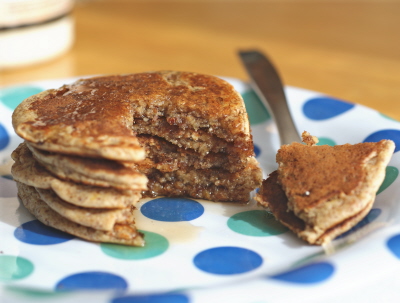
TO VIEW THE COMPLETE RECIPE, PLEASE VISIT THE NEW DIET, DESSERT AND DOGS, BY CLICKING HERE.
Last Year at this Time: Week at Warp Speed and Easy Dinner
© 2009 Diet, Dessert and Dogs
A Bowl Lotta Love
March 4, 2009
Diet, Dessert and Dogs has moved!
If you’re reading this page, you’ve landed on the old site. Please visit the new location by clicking here–and don’t forget to update your readers and blogrolls!
As always, thanks for reading. I look forward to seeing you at the shiny new Diet, Dessert and Dogs!
“Um, Mum, we are coming with you, aren’t we? Because (and sorry to have to tell you this), we actually have more fans than you do on this blog.”]
[Thanks to everyone who left such sweet comments and encouragement for the hellish week of marking! (And I know I still owe some of you emails. . . coming soon!) Some of you who are students noted that you’d be doing as much work on the other side of the red pen. Whether students, parents, teachers or the lucky few whose only connection to academia is reading about it in the newspapers–hope you all survived the past crunch week or so of midterms, study week, or finals. Now get ready, ’cause there’s a lengthy return post ahead–on to the food!]

[Base of rice and buckwheat; sautéed rapini and chard with onions and garlic; tahini-miso sauce; sprinkled with hemp seeds.]
I’m sure we’ve all met her (or perhaps we are her?): that woman who’s incredibly competent at dispensing affection, comfort, nurturing or support–yet seems to ignore her own emotional needs and physical well-being.
Well, I admit it, I’m as guilty as the next gal. Ten days away from the DDD home base had me reflecting often on this whole notion of self-love. Actually, that was only one among a plethora of topics on which I mused during the hiatus, which included (but was not limited to) the following:
- how much I miss blogging when I’m away. I was struck by a true sense of void during this time, and it astounded me. Honestly, who are “they” who post studies about the Internet and prophecies of doom regarding how it diminishes social skills or limits interactions with other people? Seriously. In some cases, I’m in contact with blog buddies more often than my “in-person” friends (some of whom live only five minutes away). Don’t let anyone tell you that the society of bloggers isn’t a bona fide community of lively, vibrant, and very much interactive people–all of you!
- how many different ways one can answer the same exam question (more than you might think, but not quite as many as the meaning of life, the universe and everything).
- how to create a tasty, grain-free breakfast pancake. I wanted something that didn’t require refined, or even whole-grain, flour–and I found it! (more on that anon).
- how this &%$!!?* winter refuses to retreat, even though it’s March already and why are you still hanging around, Mr. Jack Frost, can’t you tell you’re not welcome anymore and nobody wants you here, so just go away and don’t come back, ya big bully!
- how, with the economy as bad as it is, I’m hoping the HH and I might still save for our dream home (okay, I’d be willing to cut some of the frills and just be happy with a daydream home). And while we’re both incredibly lucky to still be gainfully employed, on the topic of saving money and stretching a dollar, I’ve been mightily inspired by the frugal and fantastic Melody over at MeloMeals.
- why, once again, I have been willing to risk my health, well-being and future for the evil (and truly, ephemeral) charms of that sepia seductress, chocolate.

[Oat groats and amaranth base; grilled eggplant and grilled marinated tofu; broccoli, avocado and green onion; orange-fig sauce.]
Yes, folks, it’s time to focus on the “diet” portion of this blog yet again.
When I first began to ponder how I’d spend my break from the college, I considered traveling to a new locale, attending a retreat, picking up old hobbies like sewing or knitting–but it never occurred to me I’d get sick instead. Then, at my annual checkup last week, I discovered that my old candida afflction has reared its yeasty head yet again, and this time, with a potency that could rival the combined superpowers of the X-Men.
I’ve decided that in order to rid myself of this recurring problem once and for all, I’ll need to return to the anti-candida diet (ACD). I’ll be facing a highly restrictive diet and a few detoxes or cleanses along the way (no wonder I’ve been avoiding it). But I’ve had it with the persistent cycle of diet, dessert and destruction (you thought I was going to say “dogs,” didn’t you? heh heh!). To paraphrase that seminal queen of weight loss, Susan Powter, “the insanity must stop!” (And what the heck ever happened to her, anyway?).
I’m going on an anti-candida diet so I can be healthy. So I can move more easily, and feel comfortable in my own body. So I can express a little more self-love and self-care through my diet and lifestyle. (Anyone familiar with Sally’s fabulous blog already knows what I mean by this: treating my body, mind and spirit with the kindness, reverence, and care it deserves.) So I can enjoy a social life without being fixated on food. Oh, and so I can lose 40 pounds by my highschool reunion this May. **
My last “true” candida cleanse occurred nine years ago, and in the interim, my eating habits have slowly reverted to those that got me in trouble in the first place (chocolate too often; sweets too often; wine too often). After reading the diet on this site (which is slightly less ascetic than the regimen I followed before), I think it’s doable (the only recommendation with which I disagree is to use aspartame or aseulfame, so I’ll just omit those).
To those of you who’ve been reading for a while, I understand if you’re skeptical, and I apologize. After all, I’ve tried more than a few times to cut chocolate and sugar from my life. Well, I’ve learned it’s never a great idea to publicly declare such a complete lifestyle overhaul on the blog, because later on, if you don’t meet your lofty goal, your initial vow is indelibly there for all the internet to see. With that in mind, I’ll restrict my candida commentary to the Progress Tracker page (may as well give it a new use, as I long ago stopped recording my weight over there).
And since I’ve already done a bit of baking over the past couple of weeks, I can intersperse the spartan dishes with more interesting fare. If I play my screens right, you folks will barely notice a difference.

[Rice and brown lentil base; spinach leaves and steamed sweet potato wedges with chopped green onions; topped with almond-curry sauce.]
The first step is to prepare the system with a week or two of clean, whole-foods eating that doesn’t worry about yeast or fermentation (yeast and fermented foods will be cleared out next). Rice or noodle bowls are a great place to start.

[Barley and amaranth base; grilled red pepper strips and onions; steamed broccoli; sprinkling of cashews and sunflower seeds; topped with tahini-miso sauce.]
Meals-in-a-bowl like these have become very popular at health-food restaurants and stores around North America. There’s a local haunt that serves an amazing bowl called, appropriately, “The Mish-Mash Bowl.” Every meal contains either brown rice or quinoa, topped with your choice of four toppings from three categories (protein, veggies, or good fats), then drizzled with your choice of one or two dressings.
My own variation on the Mish Mash is a quartet of at least one healthy grain plus a protein, healthy fat, and complex carbohydrate (ie, veggies). I was amazed at how satisfying–and how filling–a clean, healthy bowl can be. The marriage of fresh, colorful veggies with chewy grains and the crunch of nuts or seeds is entirely enchanting (almost as enchanting as that vixen, chocolate–though in a different way, of course).
In putting these together, what I discovered rather quickly is that “the sauce makes the bowl.” A grain bowl sans effective topping is sort of like a perfect outfit without the right shoes or accessories–it may be good quality, it may be tailored , it may even sport a designer label, but without the proper accoutrements, it’s just a length of beige, beige, beige.
With a winning sauce, however, these bowls are stellar; they’re delectable; they evoke impatient yearning; they’re Zagat-worthy. And, much like those lines of toddlers’ clothing that allow the kids to dress themselves by choosing one top and one pre-coordinated bottom, they’re fun to mix and match, just to see what comes up.
The combinations here are simply starting points to get you going; play around with different grains, legumes, nuts, seeds, veggies, and sauces. Use these sauces with any combination you please, or go with my mixes–either way, you’ll be treating yourself with love.
**I asked this question entirely tongue in cheek–so please, no need to send me emails detailing how unhealthy a 40-pound weight loss in 8 weeks would be! I have no intention of actually losing that much. Besides, at the rate I’ve been going this past year, a FOUR pound loss by May would be nothing short of miraculous.
Tahini-Miso Sauce
TO VIEW THE COMPLETE RECIPE, PLEASE VISIT THIS PAGE ON THE NEW DIET, DESSERT AND DOGS, BY CLICKING HERE.

Almond and Curry Sauce
TO VIEW THE COMPLETE RECIPE, PLEASE VISIT THIS PAGE ON THE NEW DIET, DESSERT AND DOGS, BY CLICKING HERE.

Orange Fig Sauce
TO VIEW THE COMPLETE RECIPE, PLEASE VISIT THIS PAGE ON THE NEW DIET, DESSERT AND DOGS, BY CLICKING HERE.

TO VIEW THE COMPLETE RECIPE, PLEASE VISIT THIS PAGE ON THE NEW DIET, DESSERT AND DOGS, BY CLICKING HERE.
© 2009 Diet, Dessert and Dogs


 Diet, Dessert and Dogs